Tank and tankless
Hemet water heaters: repair it or replace it?
In many Hemet houses the water heater stands in the garage, and most calls about it start one of two ways: the shower runs cold, or there is water on the garage floor. Either way, the decision you will face is whether to repair this heater or replace it.
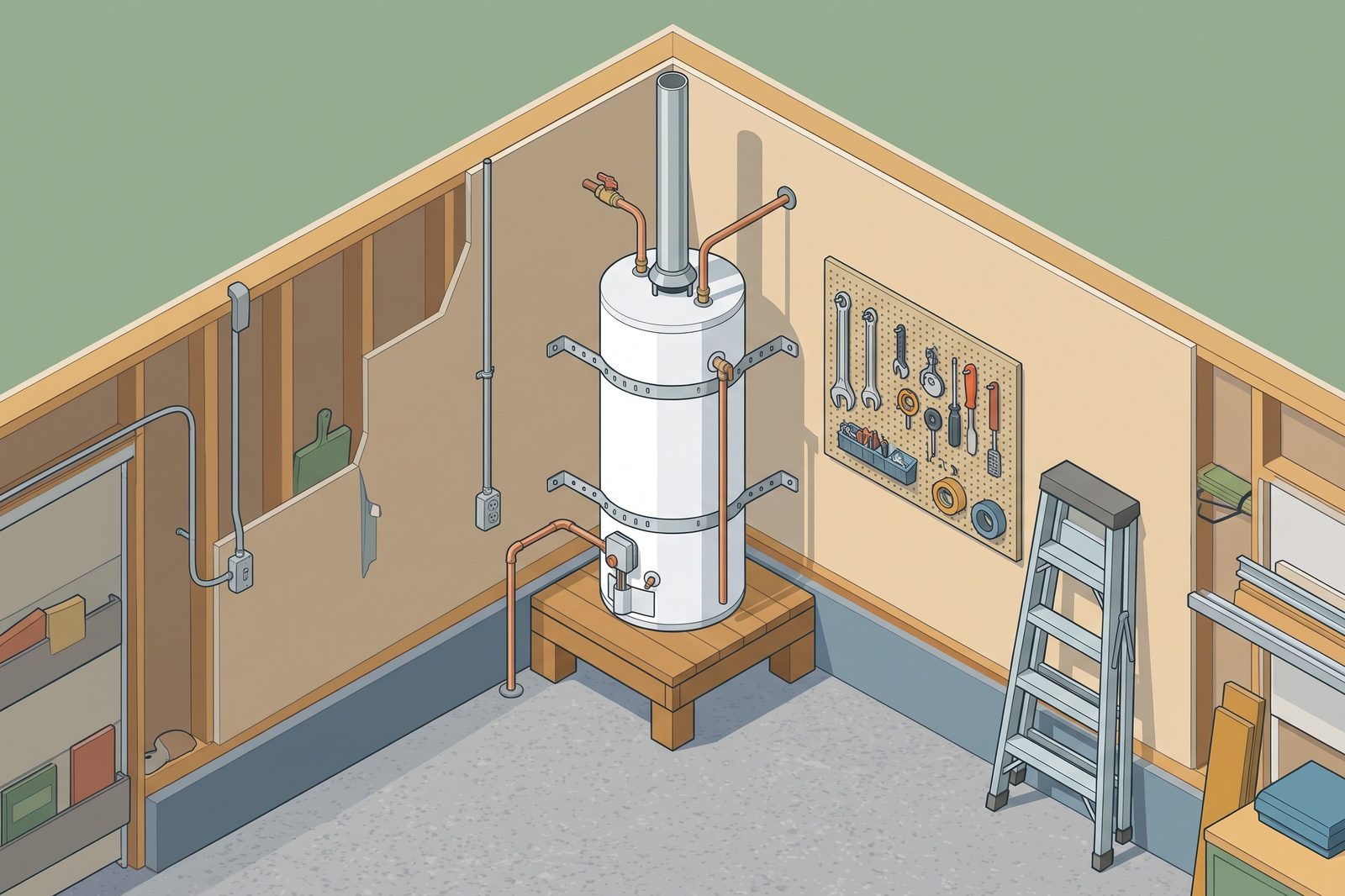
If it's leaking right now
Close the valve on the cold-water pipe at the top of the heater. On a gas heater, turn the control knob to off; on an electric one, switch off its breaker. That stops new water entering the tank and keeps an empty electric element from burning out.
Then find where the water comes from. A drip from the pipe running down the side is the temperature and pressure relief valve doing its job or failing. A puddle with no drip from any fitting usually means the tank itself has rusted through.
Inside a tank heater
What can fail, and what each failure looks like
- 1Cold-water inlet and shut-off valve. Close this first when the heater leaks.
- 2Dip tube. Carries cold water to the bottom; a broken one gives lukewarm water that runs out quickly.
- 3Anode rod. Corrodes so the tank doesn't. Once it is gone, the steel starts to rust.
- 4Temperature and pressure relief valve and its discharge pipe. Drips if pressure or heat runs too high.
- 5Sediment. Hard-water minerals settle here, rumble when heated and shorten the tank's life.
- 6Gas burner and flue. Pilot, thermocouple and gas valve faults stop the heat.
- 7Drain valve. Used to flush sediment; old plastic ones sometimes weep.
- 8Earthquake straps, upper and lower, holding the heater to the wall.
A gas storage heater cut open. Electric heaters have two elements in place of the burner and flue.
Repair or replace
How the decision usually goes
Usually worth repairing
- A pilot that won't stay lit, a thermocouple or a gas control valve
- An electric element or thermostat
- A dripping relief valve or drain valve
- A broken dip tube on a heater that is otherwise sound
Usually time to replace
- Water seeping from the tank body or the bottom seam
- Rust-colored hot water when the cold runs clear
- Loud rumbling and popping after years without a flush
- A heater old enough that the next repair would be the second or third
Choosing the replacement
Tank or tankless
Another tank heater
The simplest swap: same spot, same gas or electric connection, same venting if it is still sound. Ask whether the new tank's height and diameter fit the old platform and straps.
Size by how many showers run back to back in your house, not by the old label alone.
A tankless heater
Heats water as it flows, so it doesn't run out, but it needs a larger gas supply, different venting and often a new electrical outlet. Those changes, not the unit, are much of the job.
Hard water scales the heat exchanger. In Hemet that means planning a regular descaling flush, or treating the water first. Hard water in Hemet.
Replacement day
What happens in your garage
Water and fuel off
The plumber closes the cold valve, shuts the gas or power, and drains the old tank through a hose to a safe spot outside.
Old heater out
Disconnected, unstrapped and carried out. Ask whether the company hauls it away.
New heater set
On a raised platform where one is needed, with new flexible connectors, a sediment trap on the gas pipe and the relief valve piped to drain outside.
Strapped and vented
Two earthquake straps fastened to the wall framing, and the flue checked for clearance and draft.
Filled, lit and tested
The tank fills before the burner or elements come on. Then the plumber checks for gas leaks and watches the first heating cycle.
Permit inspection
If a permit was pulled, an inspector or the contractor's self-certification closes it out.
Permits
Who issues the permit for a new heater
Inside Hemet city limits, the City's Building and Safety handout says plumbing, electrical and mechanical repairs need a permit and inspection. The counter number is (951) 765-2475.
In unincorporated areas such as Winchester, Valle Vista, East Hemet and Homeland, Riverside County issues it. The County runs a self-certification program in which a licensed contractor signs off a like-for-like tank replacement; it does not cover tankless or solar heaters, which go through normal inspection.
In a manufactured home, a water heater replacement needs a permit from the state housing department (HCD), and the heater has to be inside the home. Manufactured home plumbing.
Questions to ask before you say yes
- Is this a repair or a replacement price, and what does it include: haul-away, new connectors, platform, straps, venting?
- Who pulls the permit, and is it included?
- For tankless: does my gas pipe and meter carry enough for it, and what venting and electrical work is added?
- What is the manufacturer's warranty on the tank and parts, and who handles a claim?
- Can you show me your C-36 license number so I can look it up before you start?
Water heater questions
Can I relight the pilot myself?
Many heaters have lighting instructions on the label and are meant to be relit by the owner. Don't do it if you smell gas, if the burner area is wet, or if it goes out again soon after; those need a plumber.
Why does my water smell like rotten eggs only from the hot side?
Bacteria in the tank react with the anode rod. A plumber can flush the tank and swap the anode for a different type.
How often should the tank be flushed?
Hard water makes sediment build faster. Ask the plumber to show you how to drain a few gallons from the valve, and how often to do it for your heater.
Is a bigger tank always better?
No. A tank much larger than you need keeps heating water nobody uses. Ask how they sized it.
Cold shower or a wet garage floor?
Say whether it is gas or electric, tank or tankless, and whether it is leaking. That tells the plumbing company most of what they need.
Reach a Hemet-area plumber
For trouble with the pipes, drains, toilets or water heater in your own home.
Call (951) 555-0137Your call may be recorded for quality. Who pays Plumber Hemet and what is kept from a call.